Answer Engine Optimization for Service Businesses

Answer Engine Optimization for Service Businesses
By Clinton Jiggetts, Founder, Best Fit Digital Updated November 2026
Service businesses earn AI recommendations by structuring their digital presence for machine readability. Our team builds clear entity relationships and authoritative content. AI-powered platforms like ChatGPT, Google AI Overviews, Perplexity, and Microsoft Copilot evaluate a limited set of trusted sources. Businesses without structured data are completely excluded from consideration.
Key Takeaways
- AI search platforms evaluate a limited set of trusted sources and synthesize a single answer rather than ranking hundreds of websites.
- Businesses without structured data are completely excluded from consideration by AI-powered platforms like ChatGPT and Google AI Overviews.
- AI systems assess whether business information is easy to find, understand, verify, trust, and connect to relevant topics.
- Traditional SEO targets ranking within search engine results pages, while answer engine optimization earns direct answers inside AI-powered platforms.
What is AI search and why does it matter for service businesses?
AI search describes platforms that evaluate a limited set of trusted sources and synthesize a single answer rather than ranking hundreds of websites. This shift fundamentally changes how visibility works for law firms, contractors, med spas, and dental practices across Maryland, DC, and Virginia. Users are no longer choosing between businesses. AI systems are choosing on their behalf.
Platforms like ChatGPT, Google AI Overviews, Perplexity, and Microsoft Copilot do not function like traditional search engines. A traditional search presents ten blue links and leaves the evaluation to the user. An AI-powered search selects a small group of businesses it understands and trusts, then delivers a conversational recommendation. For a service business, exclusion from that trusted set means complete invisibility, regardless of past SEO performance.
How does AI search differ from traditional search engines?
Traditional search engines rank pages based on hundreds of signals and display options. AI search evaluates sources and produces a definitive answer. The distinction carries direct revenue consequences. A contractor who ranks on page two of Google still has a chance of being found. That same contractor, if not structured for AI comprehension, never appears in an AI-generated recommendation. The loss is absolute.
What is the business impact of AI-driven recommendations?
The impact centers on selection, not ranking. When a potential client asks an AI tool for the best med spa in Annapolis or a reliable electrician in Northern Virginia, the platform does not offer a menu of choices. It names specific businesses. Our team structures service businesses for this selection process by building the digital ecosystems that AI platforms require to trust and recommend a business. Without that structure, even established firms with strong referrals disappear from the most rapidly growing discovery channel.
How do AI engines decide which businesses to recommend?
AI engines do not rank websites. They select businesses from a limited pool of trusted sources, extract relevant details, and synthesize a single answer. This process replaces the traditional search results page with a curated recommendation. Businesses absent from that trusted pool lose every opportunity for visibility.
The selection process follows a clear sequence. AI-powered platforms evaluate a limited set of trusted sources before including a company in their recommendations.
What criteria do AI systems use to evaluate a business?
The evaluation hinges on five distinct factors. According to industry analysis, a law firm with inconsistent addresses across directories fails the verification test. A contractor whose website buries service-area details fails the findability test. Each failure reduces the likelihood of selection.
How does local search behavior influence AI recommendations?
Local search patterns directly shape which businesses surface in AI-generated answers. Our team builds keyword strategies rooted in how local customers actually search, including neighborhood terms and service-area modifiers. An HVAC company targeting "furnace repair" misses the Annapolis homeowner searching "furnace repair near me open now." AI engines match the query's specificity to the business information they trust. Generic optimization leaves money on the table.
The process demands precision. AI platforms do not guess. They pull from structured, verified data sources that clearly state what a business does, where it operates, and why it deserves consideration. Service-based businesses in Maryland, DC, and Virginia face a binary outcome: structure information for AI comprehension or remain invisible to the growing segment of customers using answer engine optimization tools to find local providers.
What is the difference between AEO vs SEO?
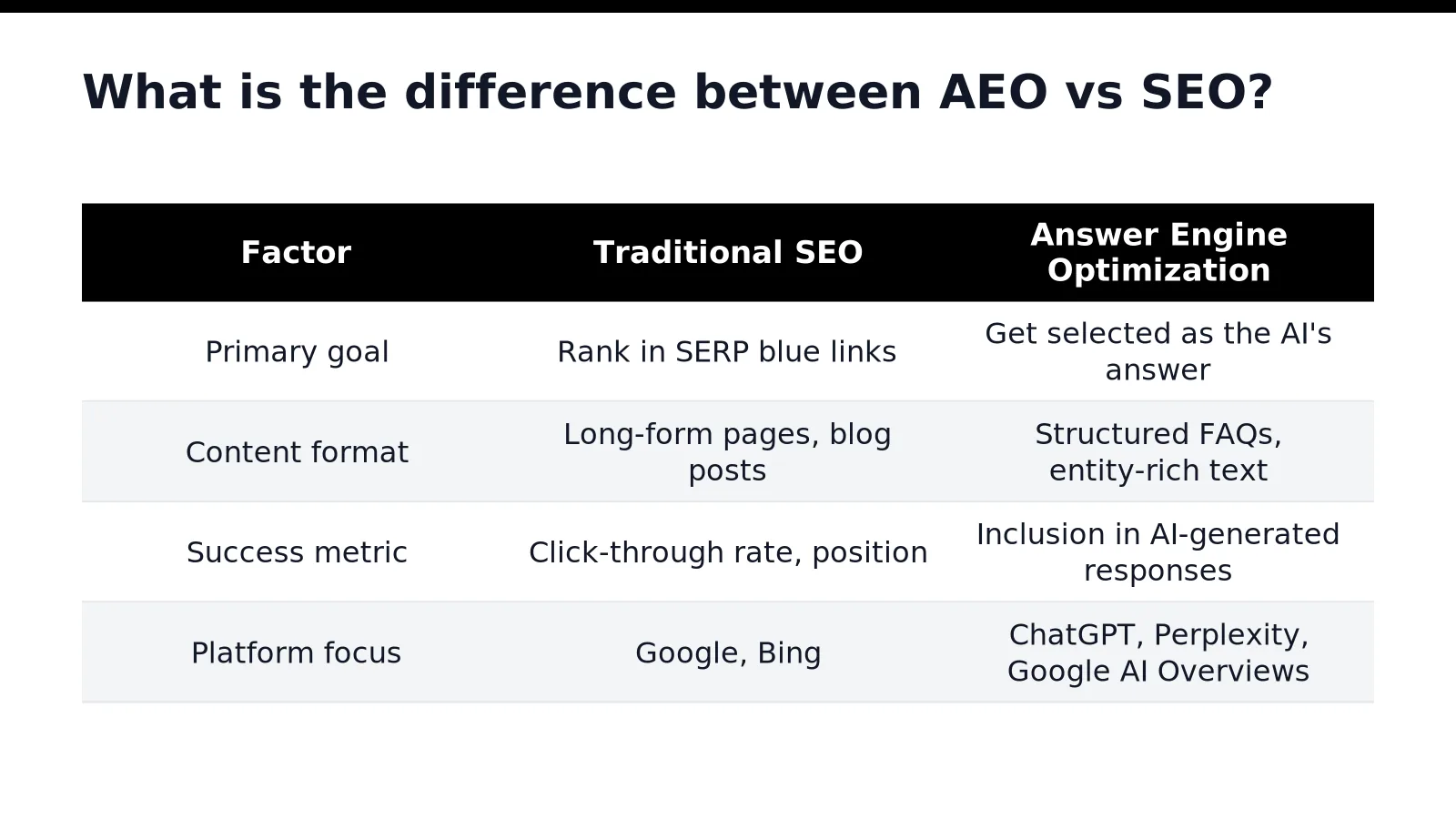
Answer engine optimization and traditional SEO serve distinct functions in digital visibility. SEO targets ranking within search engine results pages. AEO vs SEO represents a fundamental shift from earning clicks to earning direct answers inside AI-powered platforms.
The core distinction lies in the output each discipline pursues. Traditional SEO optimizes web pages to appear as blue links on Google or Bing. Generative engine optimization structures content so AI tools like ChatGPT and Google AI Overviews extract and surface direct answers. A business practicing only conventional SEO risks invisibility when potential clients ask AI assistants for recommendations.
How does answer engine optimization differ from traditional SEO?
Answer engine optimization prioritizes structured, verifiable information that AI models parse with confidence. Traditional SEO emphasizes backlinks, keyword density, and domain authority. The two approaches share foundational elements but diverge sharply in execution.
| Factor | Traditional SEO | Answer Engine Optimization |
|---|---|---|
| Primary goal | Rank in SERP blue links | Get selected as the AI's answer |
| Content format | Long-form pages, blog posts | Structured FAQs, entity-rich text |
| Success metric | Click-through rate, position | Inclusion in AI-generated responses |
| Platform focus | Google, Bing | ChatGPT, Perplexity, Google AI Overviews |
What does generative engine optimization require that SEO does not?
Generative engine optimization demands content that AI systems interpret as authoritative and unambiguous. SEO tolerates some vagueness because human readers fill gaps through context. AI models lack that interpretive flexibility. Service-based businesses in Maryland, DC, and Virginia lose AI-driven leads when their digital presence lacks this structural clarity.
Learn more about our AI search optimization approach.
Our team delivers performance-based, month-to-month digital marketing services that maximize ROI for service-based businesses in the DMV area. We build digital ecosystems optimized for both traditional search rankings and AI answer selection. No long-term contracts lock clients into rigid strategies. This flexibility matters because AI search optimization evolves faster than conventional SEO ever did. Businesses that adapt their content for AI extraction capture opportunities competitors never see.
How to show up in ChatGPT and Google AI Overviews?
Appearing in AI-generated search results requires a fundamentally different approach than traditional search engine optimization. AI search optimization focuses on making business information structured, verifiable, and answer-ready. AI platforms do not rank websites. They select businesses from a limited pool of trusted, well-documented sources. Without this structure, a service business faces complete exclusion from AI-driven recommendations.
What makes a business eligible for AI recommendations?
AI tools evaluate businesses based on three core criteria. First, the information must be complete and consistent across all platforms. Second, the business must demonstrate authority through verified listings and structured data. Third, the content must directly answer specific customer questions.
Google AI Overviews and ChatGPT pull answers from businesses that provide clear, factual information. A venue page without a guest limit cannot answer a question about a 100-person event. That missing detail keeps the venue out of the customer's shortlist. The same principle applies to law firms, medical practices, and contractors. Incomplete information equals lost opportunities.
How does structured data improve AI visibility?
Structured data markup, commonly called schema, helps AI systems understand and trust business information. This markup translates business details into a language machines process efficiently. Services offered, locations served, hours of operation, and accepted payment methods become machine-readable facts. AI platforms cite businesses they understand. Those without schema remain invisible to the selection process.
What role does a Google Business Profile play in AI search?
Optimizing a Google Business Profile is a critical first step for AI visibility for local businesses. AI tools pull from verified business data, and the Google Business Profile serves as a primary source. From initial setup and category optimization to regular post publishing and Q&A management, every element of the profile matters. Businesses that maximize these elements push into the coveted local results AI platforms reference most frequently.
Creating FAQ-style content that directly answers common customer questions improves selection chances. Each question addressed becomes another entry point for AI citation. Service businesses in Maryland, DC, and Virginia benefit when their websites anticipate and answer the exact queries potential clients ask. Our team helps businesses dominate local search results and capture the Google Map Pack with zero long-term contracts required. The company structures digital ecosystems so AI platforms consistently select its clients as trusted recommendations.
What steps should you take for AI search optimization?
AI search optimization requires a structured, four-step process. Service businesses in Maryland, DC, and Virginia must build the digital signals that answer engine optimization and generative engine optimization systems rely on. Without these steps, a business remains invisible to Google AI Overviews and ChatGPT alike.
What is the first technical step for AI visibility?
The foundation begins with a fully optimized Google Business Profile. Accurate categories, service listings, operating hours, and high-quality photos must be configured precisely. Our team maximizes every element of the GBP to push businesses into the coveted local 3-Pack. This single profile feeds data directly to AI systems that answer "near me" queries.
Read our local SEO guide for Baltimore.
How do citations affect AI recommendations?
Consistent business citations across authoritative directories establish critical entity trust signals. AI platforms cross-reference business name, address, and phone number data to verify legitimacy. Inconsistent or missing citations erode that trust. The result is exclusion from AI-generated recommendations, costing service businesses high-intent leads they never see reported.
The four essential steps for AI visibility for local businesses follow a logical sequence:
- Claim and fully optimize the Google Business Profile. Populate every field with precise, current information. Add service menus, product photos, and weekly posts. This profile serves as the primary data source for local AI queries.
- Build consistent citations on authoritative directories. Ensure identical NAP (Name, Address, Phone) data appears on industry platforms, chambers of commerce, and data aggregators. Uniformity strengthens the entity graph AI models consult.
- Publish authoritative content structured for AI extraction. Create pages that answer specific client questions directly. Content must use clear headings, concise paragraphs, and explicit subject-verb-object statements. This structure helps AI systems parse and cite the information when users ask how to show up in ChatGPT.
- Monitor AI visibility with dedicated tracking tools. Regular audits reveal whether the business appears in ChatGPT responses and Google AI Overviews. Tracking identifies gaps before competitors capture the recommendation slot.
The distinction between AEO vs SEO matters here. Traditional SEO optimizes for ranking among ten blue links. Answer engine optimization optimizes for selection as the single recommended answer. Both disciplines require technical precision. However, AI selection demands stricter entity consistency and clearer content structure. A law firm or dental practice that neglects these steps forfeits visibility in a channel that now influences a growing share of local purchase decisions.
How can local service businesses improve AI visibility?
AI visibility for local businesses requires structured, verifiable data that AI systems can trust and retrieve. Without consistent information across the web, a law firm, dental practice, or contracting company simply does not appear when a potential client asks ChatGPT or Google AI for a recommendation.
Answer engine optimization and generative engine optimization both depend on the same foundational element: accurate business data. AI platforms do not crawl the web like traditional search engines. They select from a limited set of trusted sources. A single inconsistency in a business name, address, or phone number causes AI systems to lose confidence and exclude that business from results entirely.
What data do AI systems prioritize when selecting local businesses?
AI models prioritize three categories of structured information. First, they verify core business details across multiple authoritative directories. Second, they assess review volume, recency, and sentiment. Third, they evaluate the depth and consistency of service descriptions across the web.
Service businesses in Maryland, DC, and Virginia face a specific challenge. The DMV market spans three jurisdictions with different naming conventions, neighborhood boundaries, and regulatory categories. A medical spa in Bethesda and a contractor in Arlington need their data structured to reflect these geographic nuances accurately.
How does review management affect AI search optimization?
Customer reviews serve as verified social proof that AI systems weigh heavily. AI search optimization strategies must include systematic review collection and management. AI platforms interpret review patterns as trust signals. A steady stream of recent, positive reviews across multiple platforms signals reliability. Gaps in review recency or unresolved negative feedback signal risk.
Our team brings an intimate understanding of the DMV market to this challenge. We provide direct access to senior strategists who structure business data for AI comprehension. This personalized engagement model ensures that service businesses do not just rank. They get selected.
What common mistakes hurt your chances with AI search?
AI search tools exclude businesses that fail to provide complete, consistent information. Three specific errors cause most service providers to lose AI visibility for local businesses before a prospect ever sees their name.
Why do missing website details block AI recommendations?
AI platforms cannot guess what a business page omits. That missing detail keeps the venue off the customer's shortlist entirely. Service area gaps, capacity limits, and unlisted specialties all create the same exclusion. The AI simply selects a competitor whose information answers the query completely.
How does inconsistent business information confuse AI systems?
Conflicting details across directories erode the trust AI engines require. When a law firm's address differs between Yelp and its website, the AI cannot verify which location is correct. The system then deprioritizes that business in favor of competitors with uniform information. Answer engine optimization depends on this consistency. A comprehensive roadmap for sustainable search rankings starts with auditing every citation for accuracy.
What happens when a Google Business Profile goes stale?
An unmaintained profile signals inactivity to AI systems. Google AI Overviews and other tools interpret outdated posts and unanswered questions as signs of an unreliable or closed business. Regular updates matter. From initial setup and category optimization to consistent post publishing and Q&A management, every element of the profile pushes a business toward visibility. Neglecting these updates hands opportunities to competitors who maintain active, current profiles.
How do you track and measure AI search success?
Tracking AI search optimization performance demands specialized monitoring tools. Traditional rank trackers fail to capture whether a business appears in Google AI Overviews or ChatGPT recommendations. The measurement framework requires three distinct data streams working in parallel.
What tools monitor AI search visibility?
Specialized platforms now track presence across AI-powered search experiences. These tools scan ChatGPT, Google AI Overviews, Perplexity, and Microsoft Copilot to verify business mentions. Without dedicated monitoring, service businesses remain blind to their AI visibility for local businesses and miss critical referral opportunities.
How do you attribute leads from AI sources?
Lead attribution from AI-driven queries follows a structured process:
- Configure call tracking numbers unique to AI-optimized landing pages.
- Tag all form submissions with source parameters identifying AI referral paths.
- Log direct inquiries where prospects reference ChatGPT or AI tool recommendations.
- Cross-reference AI mention data with conversion events weekly.
Our team builds fully automated funnels that capture leads, nurture relationships, and convert engagement into revenue. A performance-based, month-to-month model ties measurement directly to outcomes without long-term contracts. Service businesses gain clear visibility into which AI channels produce phone calls, form fills, and booked appointments.
What We9ve Seen in Real AI Search Results
Real-world examples illustrate the impact of AI SEO agency Maryland strategies and LLM optimization on service business growth. For instance, a private medical practice in Towson, MD, averaged about 5 website leads total from January to June 2026. After starting an SEO and AI visibility program in June 2026 focused on fixing Google Business Profile accuracy, maintaining consistent name/address/phone across directories, creating FAQ-style service pages, and steady review generation, the practice began averaging about 5 new patient inquiries per week.
Prompt Test Checklist
Service business owners should type 5 real buyer prompts into AI platforms like ChatGPT, Gemini, Perplexity, and Google—for example, 2 best emergency dentist near Glen Burnie2, 2 personal injury lawyer in Baltimore who handles car accidents2, 2 med spa in Southern Maryland open Saturdays2—and record:
- Whether their business is named
- Which competitors are named
- Which sources are cited
Repeat this test monthly to track visibility and adapt strategies accordingly.
Answer-Ready Page Template
To achieve how to show up in ChatGPT, businesses must create answer-ready pages featuring:
- A one-sentence direct answer at the top
- Who the service is for
- Service area by city/county
- Price range or how pricing works
- Process steps
- Proof such as reviews and credentials
- Frequently Asked Questions
AI engines lift self-contained answer blocks of 40 60 words from such content, enhancing inclusion.
Comparison of AI Engine Tendencies
| AI Engine | Data Sources Emphasized |
|---|---|
| Google AI Overviews | Indexed pages, Google Business Profile, reviews |
| ChatGPT Search | Bing index, third-party lists, reviews, directories |
| Perplexity | Cited web sources, recent pages |
| Gemini | Google ecosystem and Maps data |
These observed tendencies are not guarantees but offer practical guidance for AI SEO agency Maryland efforts.
FAQ
How do AI search tools like ChatGPT decide which businesses to recommend?
AI platforms evaluate a limited set of trusted sources, extract relevant details, and synthesize a single answer rather than ranking hundreds of websites.
Conclusion
Service businesses that fail to structure their data for AI comprehension forfeit every recommendation ChatGPT and Google AI Overviews would have delivered. The path to visibility demands consistent business information, active review management, and complete service descriptions across every trusted source. Service providers who audit their digital footprint and align it with AI selection criteria position themselves to be chosen, not excluded.
Ready to improve your AI search visibility?
Contact our experts to begin optimizing your service business for the evolving landscape of answer engine optimization and stand out in AI-powered recommendations today.
About the Author
Clinton Jiggetts is the Founder and Managing Director of Best Fit Digital, a Baltimore-based digital marketing agency founded in 2017 that helps service businesses across Maryland, Washington DC and Virginia win leads through SEO, paid ads and AI search visibility. A lifelong Baltimore native, Clinton holds an MBA in Entrepreneurship from Walden University, is an alumnus of Goldman Sachs 10,000 Small Businesses (Cohort 26), and has helped generate more than $10 million in client revenue.